| BBC Model A / B / B+ |
/media/museum/photos/acorn_bbcb_system_s1.jpg |
/media/museum/logos/acorn_bbcb_logo.gif |
/companies/acorn-computer |
Acorn Computer |
| label |
value |
| NAME |
BBC Model A / B / B+ |
|
| label |
value |
| MANUFACTURER |
Acorn Computer |
|
| label |
value |
| TYPE |
Home Computer |
|
| label |
value |
| ORIGIN |
United Kingdom |
|
|
|
| label |
value |
| END OF PRODUCTION |
Unknown |
|
| label |
value |
| BUILT IN LANGUAGE |
BBC Basic |
|
| label |
value |
| KEYBOARD |
Full-stroke QWERTY keyboard, 64 keys, 10 function keys, arrow keys |
|
|
|
| label |
value |
| SPEED |
1.8 MHz |
|
| label |
value |
| RAM |
Model 1 : 16 kb\
Model B : 32 kb\
Model B+ : 64 kb |
|
|
|
| label |
value |
| TEXT MODES |
80 x 32/25 (2 colors) / 40 x 32/25 (2 or 4 colors) / 20 x 32 (16 colors) / 40 x 25 (Teletext display) |
|
| label |
value |
| GRAPHIC MODES |
640 x 256 (2 colors) / 320 x 256 (4 colors) / 160 x 256 (16 colors) |
|
| label |
value |
| COLORS |
16 (8 colors + flashing option) |
|
| label |
value |
| SOUND |
3 channels + 1 noise channel, 7 octaves |
|
| label |
value |
| SIZE / WEIGHT |
41 (W) x 34.5 (D) x 6.5 (H) cm / 3700 g |
|
| label |
value |
| I/O PORTS |
UHF TV out, BNC video out, RGB vide out, RS423, Cassette, Analogue In (DB15), Econet port, TUBE interface, 1Mhz BUS, User port, Printer port, Disk-drive connector |
|
| label |
value |
| POWER SUPPLY |
Built-in switching PSU |
|
| label |
value |
| PERIPHERALS |
Controler card for 1 to 4 5''1/4 F.D. drives (1 400 F.F)\
Floppy disk unit 5''1/4 250 Ko. (3 900 F.F.)\
Numerical cassette recorder 100 Ko. (3 000 F.F.)\
Second 6502 microprocessor with card (3 |
|
| label |
value |
| PRICE |
£399 (UK 1983) - 1181 (France, February 1984) |
|
|
| photos |
| adverts |
| hardware |
| connectors |
| software |
| emulators |
| links |
| docs |
|
| title |
subtitle |
text |
image |
| BBC MODEL B |
|
|
/media/museum/photos/acorn_bbcb_system_s2.jpg |
|
| title |
subtitle |
text |
image |
| SIDE VIEWS |
|
|
/media/museum/photos/acorn_bbcb_sides_s1.jpg |
|
| title |
subtitle |
text |
image |
| KEYBOARD CLOSE-UP |
|
|
/media/museum/photos/acorn_bbcb_keyboard_s1.jpg |
|
| title |
subtitle |
text |
image |
| BACK PANEL |
|
The Econet interface isn't installed. |
/media/museum/photos/acorn_bbcb_rearconnect_s1.jpg |
|
| title |
subtitle |
text |
image |
| UNDERNEATH CONNECTORS |
|
**(1)** Tube expansion connector\
**(2)** 1 MHz bus connector\
**(3)** User port\
**(4)** Printer connector\
**(5)** Floppy disk drive interface\
**(6)** Auxiliary power output, mainly intended for the FDD unit. |
/media/museum/photos/acorn_bbcb_underneath_s1.jpg |
|
| title |
subtitle |
text |
image |
| OPENED |
|
|
/media/museum/photos/acorn_bbcb_opened_s1.jpg |
|
| title |
subtitle |
text |
image |
| MOTHERBOARD |
|
You may download the complete diagram of the motherboard.
**(1)** FDD controller\
**(2)** NEC 7002 Analogue to digital converter\
**(3)** 6850 Serial interface adapter (ACIA)\
**(4)** Cassette and RS-423 Ferranti custom chip\
**(5)** 6502 CPU\
**(6)** 6845 CRT controller\
**(7)** SAA5050 Teletext chip\
**(8)** 32 KB RAM chips (16x4116)\
**(9)** Custom chip in charge of bus and memory management\
**(10)** Two 6522s manage the various system I/O\
**(11)** Acorn DOS and BBC BASIC 16 KB ROMs\
**(12)** Underneath connectors. |
/media/museum/photos/acorn_bbcb_mainboard_s1.jpg |
|
| title |
subtitle |
text |
image |
| PROTON VERSION |
|
Rare picture of a Proton version.\
Notice that the Reset key at the right hand side of the function keys was replaced with a Break key in the Model B version.
Thanks to **Jonathan Bluestone** |
/media/museum/photos/acorn_bbc_proton_s1.jpg |
|
| title |
subtitle |
text |
image |
| VIGLEN VERSION |
|
Viglen company made this improved version of the Model B. Major changes were:\
- A new case with separate keyboard,\
- 2 built-in 5.25" FD drives,\
- Additional ROM programs,\
- Separate power supply unit.
Thanks to **Mike Holdaway** |
/media/museum/photos/acorn_bbcb_biglen_s1.jpg |
|
| title |
subtitle |
text |
image |
| BASICODE, THE TRANSMISSION OF PROGRAMS BY RADIO |
|
The BBC was one of the systems which benefited from the Basicode standard.
The principle is quite simple: every user of a computer can create a program in BASIC by respecting Basicode's rules (limited number of instructions, line length limited to 60 characters, etc.). This program is then sent through radio broadcasts and recorded by the listeners who can then transfer it to their computer.
The first broadcasts took place in 1978 for 4 types of computers: Apple 2, Edixy Sorcerer, Commodore PET and Tandy TRS 80. Basicode was then improved and became Basicode 2. In 1983, the listeners of Belgium, Germany, Denmark, England and France regularly loaded numerous programs successfully.
In England, the BBC broadcast called "Chip Chop" was very appreciated by the amateurs of Basicode. It distributed a cassette tape containing instructions of use on one side and 18 demonstration programs on the other one. |
/media/museum/photos/basicode.jpg |
|
| title |
subtitle |
text |
image |
| BBC BROADCAST |
|
The famous "Making the most of your micro" BBC broadcast featuring the Acorn BBC computer.
The BBC wanted to have their own computer to promote through these broadcasts so they signed a deal with Acorn to produce the Proton under the BBC name. |
/media/museum/photos/acorn_bbc_emission.jpg |
|
| title |
subtitle |
text |
image |
| BBC NETWORK |
|
In this university, the network is composed of 16 computers and color monitors, a single disk drive and a printer.
Every user shares the resources of the same disk drive without any waiting time, as well as a unique printer through a spooler. |
/media/museum/photos/reseau.jpg |
|
|
| title |
subtitle |
text |
image |
| UK ADVERT (JULY 1984) |
|
|
/media/museum/pubs/acorn-bbc_uk-pub_july-1984.jpg |
|
| title |
subtitle |
text |
image |
| UK ADVERT |
|
From Personal Computer World, October 1983
Here are some answers:\
"The BBC Microcomputers are the limousines of home computers. The graphics are probably the best' of any machine in this class. You are paying for Ii smart machine which would not disgrace the home of a professional."\
*Video World., Feb. '83.*
"Its design has given the BBC Micro an unrivalled potential for business, educational and serious home applications. It has been equipped to function as the heart of a system which can be expanded 10 suit its owner's need?"\
*Which Micro & Software Review, Feb. '81*
"The most attractive and exciting feature of the BBC Microcomputer is its enormous potential for expansion which will allow a higly expansive system to be built-up?"\
*Which Micro, June '82.*
"They (the graphics) are tremendously exciting, and they are one of the features that make this machine stand out head and shoulders above everything else that is available in the market place at this time"\
*Educalional Computing, May '82*
"It is expandable and has a powerful BASIC. It has superb sound and graphics, the software is readily available and the price is righ"\
*BBC Micro owner from Hampshire.*
"The basics are easy to follow. My wife has developed a program for teaching our daughter French vocabulary. Our daughter uses it mainly for games and simple programming"\
*BBC Micro owner from Co. Durham.*
"It is a very powerful computer, My husband has written his own data base. I have been writing programs and programming games. Even the children have written small programs."\
*BBC Micro owner from Devon.*
"No other computer can offer such ease of use when dealing with complex sound effects."\
*Which Micro, June '82.*
"It isn't often a journalist can sit down to write about a computer with the certain knowledge that he has never seen a nicer machine."\
*Personal Computer World, Dec. '82* "It has got huge potential. Besides playing the games, the whole family are learning basic programming."\
*A BBC Micro owner from Staffordshire.*
"Everything possible seems to have been done to ensure that this is not a 'dead end' machine.."\
*Personal Computer World, July '82.* |
/media/museum/pubs/acorn_bbc_pub_s1.jpg |
|
| title |
subtitle |
text |
image |
| SECOND 6502 |
|
The Second Processor option features, in a separate case, a 3 MHz 6502 processor and 64 KB of RAM. It was connected to the BBC system through the Tube channel. The BBC RAM was then used as video RAM, so the full memory area of the Second Processor was available for user programs.\
Two ROMs was also delivered. The first one holded a new BASIC version called HI-BASIC that made full use of the new memory configuration. The other updated disc or Econet filling system.
Courtesy of **8BS.com** |
/media/museum/pubs/acorn_bbc_secondprocadv_1.jpg |
|
| title |
subtitle |
text |
image |
| F.D. UNIT ADVERT |
|
BBC floppy disc unit was delivered with a 8271 FD controller chip and a Filing System software in ROM to be fitted into the BBC system.\
Two versions of F.D. units were available:\
- A single drive unit, single side, single density, 100 KB space.\
- A dual drive version, double side, double density, 800 KB space.
Courtesy of **8BS.com** |
/media/museum/pubs/acorn_bbc_fdpub_1.jpg |
|
| title |
subtitle |
text |
image |
| FRENCH ADVERT #1 |
|
"Carefully, one last time... I compared everything and I offered myself a BBC"
Lucky guy, he must be rich at more than 6300fr the BBC... At the end of the text we can read :
"The price : 6300fr maximum. Of course it's not given. More expensive than some (but I had already eliminated them)." !!
At least they are honest. |
/media/museum/pubs/acorn_bbc_pub_1.jpg |
|
| title |
subtitle |
text |
image |
| FRENCH ADVERT #2 |
|
"A step toward the future"
Hmmmm..... |
/media/museum/pubs/acorn_bbc_pub_jcs_1.jpg |
|
|
| title |
subtitle |
text |
image |
| ROM PAGING CARD |
|
There are four ROM sockets in the standard BBC but the OS supports up to 16 sockets. The Watford 13 ROM board allows up to 16 16 KB ROMs to be selected at any one time by the OS. |
/media/museum/hardware/acorn_bbcb_romcard_s1.jpg |
|
| title |
subtitle |
text |
image |
| LIGHT PEN |
from RM Electronics |
This lightpen is connected to the "Analogue In" socket. It is delivered with some software, including "Color Graphic". |
/media/museum/hardware/acorn_bbc_lightpen.jpg |
|
| title |
subtitle |
text |
image |
| VOLTMACE DELTA CONTROLLERS |
|
Voltmace modified its Database videogame system controllers to be sold for micro-computers, mainly Acorn systems : BBC and Electron (with Plus-1 interface). As the keypad was of no use anymore, it was reduced to only 3 fire buttons. |
/media/museum/hardware/voltmace_joysticks.jpg |
|
| title |
subtitle |
text |
image |
| 5''1/4 DISK-DRIVE |
|
|
/media/museum/hardware/acorn_bbc_disk-drive_1.jpg |
|
| title |
subtitle |
text |
image |
| BBC FLOPPY DISK-DRIVE |
|
It was rather slow and used 100 KB floppy disks. |
/media/museum/hardware/acorn_bbc_floppy.jpg |
|
| title |
subtitle |
text |
image |
| CUMANA F.D. UNIT |
|
Cumana CSX-400S. BBC Compatible 5.25" disk drive. Selectable 40/80 track, single/double sided, 200/400 KB capacity. |
/media/museum/hardware/acorn_bbc_cumanadrive_1.jpg |
|
| title |
subtitle |
text |
image |
| TORCH Z80 DISK PACK |
|
The Torch Disk Pack made it possible for the BBC user to run the CP/M operating system and use its vast range of software. The system included a Z80 microprocessor and 64 KB of additional memory. Some of the components were installed in the BBC computer.
**(1)** The Z80 microprocessor replaced the BBC's 6502.\
**(2)** 64 KB RAM dedicated to the Z80 and CP/M.\
**(3)** The Torch card was inserted into the BBC case and fixed with these fasteners.\
**(4)** The Z80 card was connected to the BBC through the 'tube' interface.\
**(5)** Some additional components had to be inserted on the motherboard.\
**(6)** Two 5.25'' 400 KB disk drives. Each drive was seen by CP/M as two 200 KB virtual drives.\
**(7)** Drive cable connected to the BBC disk drive interface.\
**(8)** These power cords had to be disconnected from the BBC motherboard when the Torch system was connected.\
**(9)** Power is supplied by the Torch unit, the BBC power supply no longer being used.\
**(10)** Power wires coming from the Torch power supply.\
**(11)** ROM chip holding the CP/M operating system (Torch called it MCP). |
/media/museum/hardware/acorn_bbc_torchdiskpack_1.jpg |
|
|
| title |
subtitle |
text |
image |
| BACK CONNECTORS |
|
looking at the BBC back panel. |
/media/museum/connectors/acorn_bbcb_connectors_s1.jpg |
|
| title |
subtitle |
text |
image |
| JOYSTICKS CONNECTOR |
|
A pair of analog joysticks can be connected to this unique 15-pin connector of which only 12 are used. The connector is found at the back of the computer. The connections of both joysticks are perfectly symmetric.
(1) Right fire button\
(2) Right up/down moves\
(3) Right left/right moves\
(4) Left up/down moves\
(5) Left left/right moves\
(6) Left fire button |
/media/museum/connectors/acorn_bbcb_connjoys_s1.jpg |
|
|
| title |
subtitle |
text |
image |
| BOULDER DASH |
|
|
/media/museum/software/acorn_bbc_boulderdash_ss.gif |
|
| title |
subtitle |
text |
image |
| CITADEL 2 |
|
|
/media/museum/software/acorn_bbc_citadel2_ss.gif |
|
| title |
subtitle |
text |
image |
| CHUCKY EGG |
|
|
/media/museum/software/acorn_bbc_chucky-egg_ss.gif |
|
| title |
subtitle |
text |
image |
| CYLON ATTACK |
|
|
/media/museum/software/acorn_bbc_cylon-attack_ss.gif |
|
| title |
subtitle |
text |
image |
| DAMBUSTERS |
|
|
/media/museum/software/acorn_bbc_dambusters_ss.gif |
|
| title |
subtitle |
text |
image |
| ELITE |
|
|
/media/museum/software/acorn_bbc_elite_ss.gif |
|
| title |
subtitle |
text |
image |
| THE WAY OF THE EXPLODING FIST |
|
|
/media/museum/software/acorn_bbc_exploding_ss.gif |
|
| title |
subtitle |
text |
image |
| FORTRESS |
Zaxxon clone |
|
/media/museum/software/acorn_bbc_fortress_ss.gif |
|
| title |
subtitle |
text |
image |
| GRAND PRIX CONSTRUCTION SET |
Title screen |
|
/media/museum/software/acorn_bbc_grandprix-cs_ss.gif |
|
| title |
subtitle |
text |
image |
| GRAND PRIX CONSTRUCTION SET |
|
|
/media/museum/software/acorn_bbc_grandprix-cs_ss2.gif |
|
| title |
subtitle |
text |
image |
| MAGIC MUSHROOMS |
|
|
/media/museum/software/acorn_bbc_magic-mushrooms_ss.gif |
|
| title |
subtitle |
text |
image |
| MATCHDAY |
|
|
/media/museum/software/acorn_bbc_matchday_ss.gif |
|
| title |
subtitle |
text |
image |
| METEORS |
|
|
/media/museum/software/acorn_bbc_meteors_ss.gif |
|
| title |
subtitle |
text |
image |
| MONSTERS |
|
|
/media/museum/software/acorn_bbc_monsters_ss.gif |
|
| title |
subtitle |
text |
image |
| NEVRYON |
|
|
/media/museum/software/acorn_bbc_nevryon_ss.gif |
|
| title |
subtitle |
text |
image |
| RAID OVER MOSCOW |
|
|
/media/museum/software/acorn_bbc_raid_ss.gif |
|
| title |
subtitle |
text |
image |
| RAVENSKULL |
|
|
/media/museum/software/acorn_bbc_ravenskull_ss.gif |
|
| title |
subtitle |
text |
image |
| SIMCITY |
|
|
/media/museum/software/acorn_bbc_simcity_ss.gif |
|
| title |
subtitle |
text |
image |
| WAR |
Title screen |
|
/media/museum/software/acorn_bbc_war_ss.gif |
|
| title |
subtitle |
text |
image |
| ZALAGA |
Galaga clone |
|
/media/museum/software/acorn_bbc_zalaga_ss.gif |
|
| title |
subtitle |
text |
image |
| ZANY KONG |
Donkey-Kong clone |
|
/media/museum/software/acorn_bbc_zany-kong_ss.gif |
|
|
|
|
|
|
|
|
|
|
|
|
|
|
|
| title |
url |
text |
| The BBC and Master Computer Public Domain Library |
http://8bs.com/ |
Lots of stuff to see and download |
|
| title |
url |
text |
| The BBC Lives! |
http://bbc.nvg.org/ |
The net's largest site catering for enthusiasts of Acorn's range of 8-bit micros |
|
|
|
|
|
|
|
|
|
| author |
date |
text |
| Dox (Australia) |
Monday 23rd April 2012 |
I couldn''t resist a trip down memory lane. First, a long overdue "Thank you" to Mr Hume.
His whole Math''s class was caught up in his enthusiasm, excitedly awaiting the day when his Micro Computer would arrive. It was late.
When it did, a small cadre of boys and girls gathered around the keyboard and monitor to watch as he loaded a few worthy but dull games. I seem to recall, only one or two got hands-on because they took so long to load.
The following week, everyone else was rehearsing for the school play. That evening, he changed the course of my life.
All I''d ever seen a computer do was play a few simple games. When asked what I wanted to do, I was too naive to know better.
I asked if we could "type-in a game". And to my amazement, he did just that. For years after, "typing-in a game" meant copying from a magazine. I knew differently.
Writing BBC BASIC in real time, Mr Hume crafted one of the few games I''d seen before ... "Bomber". Life. As I watched. We didn''t finish it in one night, nor ever as I recall. but I''d seen enough. I was hooked. I was consumed with the desire to do the same. I had to speak "fluent computer".
Within 6 months, I''d able to do the game. Taking a simple idea and turning it into code.
Within a year, I was coding in fluent machine code (hex, not assembler). Within a year, I was in high school and coding passionately. Along with a couple of mates, we wrote most of the senior schools'' computing assignments during our first term. LOL. Stopped us being bullied, oddly enough. Being able to write games made us geeks tolerable, even useful. We were awarded special privileges by the tougher kids and the teachers. It could have been so much worse.
My own first computer was a VIC-20. An amazing gift, that my single mum couldn''t really afford. Later on, I managed to snag my BBC (an old model A) ... and loved it with a passion. Then the ST, my beloved Amiga and then the wilderness of MS-DOS until Linux and for the last decade, my Mac''s.
It''s 30 years since the ZX Spectrum was released. A machine that I loved and loathed (fan-bois are not new). Nothing will ever compare to the BBC. (Arch, if you ever read this ... the Z80 was definitely better :-)
How good was BBC Basic? And lightening fast. Procedures, wow. And the assembler. Econet. And of course, Elite.
Thank you to Acorn, the BBC, Mr Hume. Arch and Beef. It''s 29 years later, I''m awake at 3am still coding furiously. Good night. |
|
| author |
date |
text |
| Peter Gathercole (Somerset, United Kingdom) |
Sunday 7th May 2006 |
I was responsible for equiping a teaching lab. at Newcastle Polytechnic, and natrually I chose the BBC micro (a controversial decision when everyone else was buying original IBM PC's). 16 model B (suitable for a class of 32), networked together with ECONET to a server with a 20MB hard disk. I was given a free hand to buy 'demonstrative' hardware to show what computers could do. We ended up with robotic arms, 2 different speach synths, graphic tablets, 2 different camera systems, a speach recognition system, a BITSTICK (great for playing Elite), touch sensitive screens, light pens, pen plotter, Teletext adapter, 6502 second processor. The systems were used for Basic and Pascal programming, word processing (view), spreadsheets (viewsheet). With all of the 'toys' out, it really was something to see. All this connected to the 'standard' ports of the BBC. What a wonderful machine. I know from experience that it was a great system for teaching. I still have two running today! |
|
| author |
date |
text |
| Alan Goodwin (UK) |
Wednesday 8th September 2004 |
Let's face it; everyone has used a BBC. Schools loved 'em...and rightly so. The real draw, though, was seeing "Elite" running on it. I started coding 3d vector routines as a result, whilst I got my 'o' level in computer studies with three programs I made for fun (a crude music sequencer, a bug-ridden 3d graphical adventure game and a simple word processor). Biggest surprise the old girl gave me was when I slammed in my new copy of Superior Software's "Citadel" and she started TALKING to me! "Whatch owt for speeeech!", she said, "Ower new program, coming soooon!".
I dropped my sandwich! |
|
| author |
date |
text |
| Caroline (Hampshire, UK) |
Thursday 29th January 2004 |
My ex husband was an electronics technician in the RAF and when he came out of the forces at the end of the 70s he also got into computing. He bought a computer kit from an electronics magazine for £500 (which was delivered in a Securicor security van) and assembled it himself.
When the BBC B came out, we bought one, with a green-screen monitor and a dot-matrix printer. Backup storage to tape.
I taught myself BASIC programming on it and got seriously stuck into graphics and small utilities.
The problem with the graphics (wireframe, not solid in those far-off days) was that it took at least an hour to plot each one so if you got one of the co-ordinates wrong and it didn't come out the way you wanted it to, you had to wait another hour or more for it to cycle through again to see whether you'd got it right.
I remember trying to bribe, threaten and otherwise corral my kids into helping me debug huge pages of BASIC code from the tractor-feed striped-paper printouts with rows of holes down each side.. |
|
| author |
date |
text |
| Timmy (Uk) |
Thursday 5th May 2022 |
Look for help with a bbc microcomputer |
|
| author |
date |
text |
| ANDREW (SCOTLAND) |
Monday 16th April 2018 |
IT LOOKS LIKE SOME THING I WOOD FIND IN MY GRANNYS ATIK |
|
| author |
date |
text |
| Simon Anthony (Australia) |
Sunday 24th July 2016 |
Does anyone remember my software ? Did anyone actually use it? I once worked for ECS which branded my products. Does anyone remember my articles in Acorn User and Archimedes World ? - and Archive for that matter ?
I''m told my NewSaver prog was used in schools in Wales, UK not NS.
I''m just wondering... |
|
| author |
date |
text |
| Amir Hussain (Pakistan) |
Tuesday 7th July 2015 |
This was the first computer I ever touched . . . . . . Still remember the amusement of that touch.. After taking few programming classes I decided to write the CowBoy Shooting game in the BBC Basic. Started writing the code and ended up with just a screen replicated from the game scene into BBC Basic.
That was the time I never thought of anything else....
My teacher Mr. Moosa Kazmi, was the person who encouraged..... |
|
| author |
date |
text |
| Rick Galbraith (Winnipeg, MB Canada) |
Wednesday 26th June 2013 |
It was the summer of 1986 and I had some free time on my hands. The public library in Dryden, Ontario, a pulp-mill town in northwestern Ontario, had just received 6 BBC B+ (North American version). They offered a course in basic computing. So my first computer experience was on the BBC. I was 36.\
A couple of months later, I took a job in another town for three months. Then, I came back to Dryden and started to write an article about a person in that other community. I composed it on the BBC.\
We had an Epson Printer at the library. I bought my own printer cartridge as I typed a lot of pages and didn''t want to use their supplies. I think there was a charge for their supplies.\
In 1990, my wife bought me a present: It was a BBC that had been owned but never used by another library. I acquired a printer, and a copy of the Oak Leaves printer driver. I had fun using that driver to implement the print settings through the View word processor and the highlight codes.\
The BBC is gathering dust in my basement. I fiddled with the floppy drive jumpers and lost the settings. I burned out 2 of the kimtron monitors.\
I''ve gone on to use various flavours of Linux (after being for a short time a Windows user, from 1997 until 2002), But the BBC was fun.\
One memory was of a computer game called Pirate. I copied the disc and could play the game, but could never read the basic program. Using BBC basic, I was able to perform some operations on that disc. The disk file table took two sectors. There was a twelve character title space. The name Pirates was in that space, separated by spaces. But the spaces were not ASCII 32, but ASCII 00. This made the file system unviewable! Then I made a program to rebuild the Basic Program, and I was able to see an extra character in each line that hid the program from displaying on screen. sneaky. |
|
| author |
date |
text |
| bbcbfan |
Thursday 28th March 2013 |
can someone help me , i have a bbc b with poorman''s sideway ram $) ( a eeprom + little chip mounted and some wires for write protect and not wire protect. do some have the schemaic of this , it''s to long ago , but the problem is the switch write protect and not write protect is broken\
there is also a risitor bij de not write protect option
which old magazine explain how to make this poorman''s sideway ram ??? |
|
| author |
date |
text |
| Phil Caldwell (London, UK) |
Wednesday 27th February 2013 |
Jimi (Manchester) - Wednesday 20th June 2007
Jimi, couldn''t agree with you more.
I build PC''s for fun now, I lecture in computer engineering in my spare time and I am basically the go-to guy at work for my manager when the company PC''s fail in the different sections of the building.
My colleagues don''t even bother with the IT section as they are based in the north, we''re in London.
The curriculum these days must be so mind numbing for students. |
|
| author |
date |
text |
| Phil Caldwell (London, UK) |
Wednesday 27th February 2013 |
I remember using these computers when I was at school, looking at this website brought so many happy memories flooding back.
One quite funny, I was in fourth year and I could not get a program to run, it was around 600 lines of BASIC, it kept coming back syntax error, I''m sure you all remember this problem.
I tried for around an hour to get it to run, all of a sudden this horrid little second year kid stood behind me and said you''ve made a mistake in line 150 or there-abouts, I can''t remember now.
I looked back, still couldn''t find the error, he simply stood beside me entered some code on the keyboard and lo and behold it damned well worked.
I always despised that kid after that. Looking at this site made me think of that and gave me a really good laugh.
People these days don''t know how papmpered they are with mouses, CD Roms, Gigabytes of RAM, multi Ghz processors and so on. Oh the good old days.. |
|
| author |
date |
text |
| James Cresswell (UK) |
Monday 29th October 2012 |
Just thought I would add my penny''s worth on the fantastic BBC Micro model A. It was the very first computer I was introduced to and from the very first day, I was hooked. The school I was in, was one of the first to have a school computer and because it was a boarding school, I was on that machine day and night, with only the glow of the green monitor for company. I must have wrote dozens of programs, and to see the massive program ''RUN'' for the first time was the best buzz I ever had. Of course computers now are far superior, but sometimes I crave to get behind that green monitor again and sit up all night writing lines of code. The BBC Micro may be consigned to history now, but it will always have a special place in my heart, as it was so special to me when I was growing up. |
|
| author |
date |
text |
| Mike Cook (Manchester England) |
Tuesday 10th May 2011 |
A video of the 1985 Micro User show in Manchester:-\
http://vimeo.com/23537869 |
|
| author |
date |
text |
| Mark Cardy (Northern Ireland) |
Monday 25th April 2011 |
I Had A BBC ''B''. Got it for Christmas 1983. it was the best thing that i''d ever got. i learned the Language, and some of the Advanced language (assembly if i remember right). i noticed that the BBC was alot quicker than any other PC in that era, even IBM etc. What happened? why did it not take over the world? It was so quick, easy to use, British, etc. |
|
| author |
date |
text |
| Gordon McIntosh (UK) |
Wednesday 6th April 2011 |
I remember using your computer lab Peter and the robotic arms - these were great machines |
|
| author |
date |
text |
| Ben McPherson |
Friday 18th March 2011 |
Caroline, Peter, I''d be very interested to hear more from you about your experiences with the BBC Micro. Do email me if you''d be interested in sharing - other users too. I may be making a short film about the BBC Micro. |
|
| author |
date |
text |
| Kevin (Scotland) |
Wednesday 19th January 2011 |
Remember at primary school every class from P3-P7 would get its allocated day on the BBC B....everyone used to eagerly wait on their turn to get on for just 5 minutes. The dangerous thing was always the BREAK key - which on a BBC terminates the program and lands you right back at the command prompt. Remember there was one day when someone did that and everyone else missed their turn for that week because the teacher couldn''t be bothered loading the program in again from cassette....everyone else in the class was totally gutted. He wasn''t popular in the playground that afternoon LOL |
|
| author |
date |
text |
| Helmut (Germany) |
Friday 14th January 2011 |
Hi , I have got 2 BBC Micro, DD drive, 1 Acorn Electron, all hardly used. Anybody interested? |
|
| author |
date |
text |
| Lez Anderson (England) |
Tuesday 14th September 2010 |
Has anyone put the BBC onto a FPGA (Field Programmable Gate Array) I believe it''s already been done for some other old computers like the Coco 3 (25MHz !!!) and Amstrad CPC..
If anyone has any information regarding this please post a message with Web link etc .. |
|
| author |
date |
text |
| Chulang Searles (Barbados) |
Friday 2nd July 2010 |
I had use it when I was doing my electronic course in 1991 for plant control modules. It was fanstatic to use and easy. I wish that PC could be as simple to program and interface to as these devices could |
|
| author |
date |
text |
| Chulang Searles (Barbados) |
Friday 2nd July 2010 |
I had use it when I was doing my electronic course in 1991 for plant control modules. It was fanstatic to use and easy. I wish that PC could be as simple to program and interface to as these devices could |
|
| author |
date |
text |
| Warren Heyes (United kingdom) |
Wednesday 5th May 2010 |
I have a BBC computer, colour monitor, dual drive, tape recorder, rom expansion board, manuals, software, joystick etc. going begging. Only monitor lead missing. Not used for years so can''t be sure it all still works. Anyone interested? - Cheshire/Merseyside area |
|
| author |
date |
text |
| Paul (Yorkshire, UK) |
Sunday 2nd May 2010 |
Kev, I''m in Sheffield and would be happy to pick up the Beeb stuff from you. My mobile is 07949263072. |
|
| author |
date |
text |
| Kev Martin (UK) |
Friday 30th April 2010 |
I have two BBC 32k computers, disc drives, two monitors (one colour) many ROMs, books and discs. Last udes many years ago and working then. Anyone interested? Free for collection from Brigg, North Lincolnshire or they will be thrown away.\
Kev |
|
| author |
date |
text |
| Antony Franks (West Yorkshire, UK) |
Tuesday 28th April 2009 |
I have a BBC Model B, S/N 02-B01-215984\
Bought in (I think) mid/late 80''s\
Sidewise extra ROM board, Watford DFS, Watford 32k RAM board, iinterWord, iinterSheet, interChart, Watford mouse. No cables, manuals but makes the OK noise when switched on. Due to house move this must go - free to anyone who can collect otherwise it''s for the skip! |
|
| author |
date |
text |
| Philip Black (Sussex, UK) |
Wednesday 1st April 2009 |
Hi Carol, I would love the Beeb computer. But how can I get in touch with you? |
|
| author |
date |
text |
| Carol (Kent, S$E$ England) |
Wednesday 28th January 2009 |
I have been given a BBC Micro model B computer in full working order with external disk drive/RAM drive, monitor and memory expansion.\
I would like to give it to anyone who can collect it from me in Kent S E England. |
|
| author |
date |
text |
| Nigel Bevan (Bristol UK) |
Wednesday 12th March 2008 |
I have to downsize and have a lot of Acorn memorabilia. Includes: Master, Risc600, hundreds of discs, monitor, drives (5 1/4 and 3") bound sets of Micro User, Archimedes World, Acorn World and lots of other stuff.\
Do you know who might be interested in buying any of this stuff? Contact me by e-mail and I can let you know what else I have. |
|
| author |
date |
text |
| Joe hardisty (manchester) |
Friday 19th October 2007 |
i have a bbc computer for sale of anyone wants it, i payed 40 with postage, and i would idealy like £30 for it, as i am running low on funds hehe |
|
| author |
date |
text |
| Steve (Australia) |
Saturday 6th October 2007 |
Does anyone in Australia have a 5.25 inch disk drive for the BBC they'd like to sell? I've just bought a BBC setup from eBay with disks of classic games, but the disk drive is knackered. I even have a Z80 second processor that I'd consider swapping for a 6502 Second Processor. My email is\
stephenknoxbigpondcom
Thanks |
|
| author |
date |
text |
| jimi (manchester) |
Wednesday 20th June 2007 |
has anyone noticed almost everyone who used a bbc in school managed to get an o level in I.T. or a degree in programming or at the very least some experience in programming that shows how rubbish the modern curriclum is!!! take that blair and i hav 1 waiting for the new guy taking his place. |
|
| author |
date |
text |
| jimi mc (manchester) |
Wednesday 20th June 2007 |
oh yes and does anyone know it a modern 3 1/2 floppy drive is compatible with a model b??? woul help for game transfer |
|
| author |
date |
text |
| jimi mc (Manchester) |
Wednesday 20th June 2007 |
MAN bbc's rule i hav a model b and a cumana floppy disc but no games and why the hell couldnt they just have used the same type of cassette interface as a 48k spectrum that might explain why i have no games but 13 and loving it!!! |
|
| author |
date |
text |
| joshua01793 (swindon) |
Friday 15th June 2007 |
hell i love the bbc computer i am oly 14 and i no most of bbc basic i do not have one but i do have the beebm on my pc so i can pracits |
|
| author |
date |
text |
| John Nuttall (Guildford) |
Sunday 10th June 2007 |
I've just been given a working BBC micro, a real nostalgia trip. It boots with message\
ACORN MOS\
Acorn 1770 DFS
How can I tell which model I have and what RAM is installed please? |
|
| author |
date |
text |
| TOM (UK) |
Tuesday 27th March 2007 |
David Glass (Scotland) - I think you're talking about grannies garden, if you're still looking. if anyone can tell me the name of the games i'm after mentioned below (TOM (UK)), i'm still looking! |
|
| author |
date |
text |
| martin overthrow (harlow (uk)) |
Monday 19th March 2007 |
As an engineer i loved the old BBC, i could up grade an A to a B in about 45 minutes. they were a joy to use and to fix.\
does anyone remember the Master 128 and the Doomsday Project? it was a Philips Laser Vision Player connected to a Master 128 with a special interface to control the laser disc player. |
|
| author |
date |
text |
| Daniel Clohesy (Australia) |
Monday 5th February 2007 |
I remember that my primary school in Paddington, Sydney, Australia was one of the first public (state) schools to have a "computer room". The very first computer I used was the BBC micro which we thought was pretty flash! We used C64's aswell but my fondest memories of the BBC was playing "Elite" with the school principle. |
|
| author |
date |
text |
| David Glass (Scotland) |
Monday 29th January 2007 |
I vaguely remember this rpg style game where one of the levels you came across dragons of all colours. You had a puzzle to solve but I cant remember what it was. I think it was feeding them?
Does this make sense and does anyone know the game i'm remembering? |
|
| author |
date |
text |
| Will Bowman (UK) |
Thursday 28th December 2006 |
There is a BBC Model B working still in the local primary school. As far as I can tell, it'll stay there til it breaks down, which hopefully won't be any time soon... |
|
| author |
date |
text |
| Paul D (UK) |
Wednesday 30th August 2006 |
The BBC B was the first computer i bought and i drooled over the specification even before they were in production. I think i pre-ordered mine, but i can't be sure. It probably helped start my software developing career, at the time i was a graduate trainee engineer and was learning the job of writing assember code. There were some good game for it, including the then addictive space trading classic, Elite. |
|
| author |
date |
text |
| Paul (England) |
Sunday 9th July 2006 |
I have just got a BBC model B computer, when I powered it up there are no beeps from the machine and no out put to the TV i have checked the fuse and that is ok, Has any one else had any problems with this and could point me in the right direction. Thanks Paul |
|
| author |
date |
text |
| John Stocking (Norfolk UK) |
Tuesday 30th May 2006 |
I am looking for a 'Bitstick' ROM for a BBC Micro if anyone has one they wish to dispose of please email price etc and I will get back to you\
thanks\
John |
|
| author |
date |
text |
| Jon (UK) |
Monday 22nd May 2006 |
Hi
I bought an Acorn computer recently... I don't know a great deal about them, but when I started it up, all I get on the monitor is flashing dashes running across the screen - is it completely broken or is there a way of sorting this problem out?
Thanks!
Jon |
|
| author |
date |
text |
| Abdullah S. Eyles (Adana, Turkey (was in UK then!)) |
Thursday 23rd March 2006 |
We had a BBC B in 1986! I wrote some programs for my Father to use in his work with BBC Basic.
One time the printer (Epson FX80) was printing strange characters. A quick look at the circuit diagram revealed a possibly faulty IC which I dilligently removed. A quick search of my electronic cupboard for a replacement, within one hour up and running again! :)
Try that with a Pentium IV or whatever junk we are using today!! |
|
| author |
date |
text |
| joe hardisty (stalybridge) |
Tuesday 10th January 2006 |
WOW the bbc micro computer is a fantastic computer i remember getting one arround 1995 i was about 7. i have just got into them again and i was wondering if there is anyone out there who knows of any basic programing language on the internet? (i suppose there wont be anyone because i char wrong and you had to start all over! lol) what a fantastic machene they were i have built many windows computers and they are really not a patch on the bbc! i know you must think i am mad but really when you put it into perspective think of the money you have to pay for ram, graphics cards, harddrives, the bbc took all these things (exept the harddrive) and put together a machine that you could play games on that would keep me happy four hours, word proccessing program and listening to the old epson printer fire all its little pins at the paper as in those days they were the "range". the bbc micro computer was an in-expensive, and efficient way to compute and did everything to the best of its abbility! well put it this way they are still going now 25years on and most havent missed a beat! (please feel free to add me on msn or e-mail me at anthonyh055@hotmail.com) |
|
| author |
date |
text |
| TOM (UK) |
Thursday 15th September 2005 |
Wow, i can't believe someone could help, thanks, i think that is the game i was describing. I'll have to give it a try and see. I don't remember it being monochrome, but memory does things like that to you, doesn't it? i'd got it into my head that it was called alchemist, but that's an entirely different game.
http://www.vgmuseum.com/images/spectrum/03/alchemist.html
there are a few other games i'm trying to find. it'd make me happy if anyone knows what these are-
* an adventure a bit like granny's garden (on the BBC, i played it at school), but which featured a top down view bit where you had to move your person (car?) around in real time picking up little flashing things, i think, before a time limit ran out (i think). a bit vague, i know, but i'd like to see it again.
*a text adventure, also on the bbc, where (i think) you and your apprentice (you may have been sherlock holmes, or something like that) had to explore a transylvanian castle, possibly looking for a vampire. i remember a front passage being described as musty when you typed "LOOK".
* a commodore 64 game where you walked around with a view similar to zelda 1, planting and harvesting mushrooms, building fences, then calling for a rocket ship to pick all of your harvest up. it always seemed to crash (the ship, i mean). you could press some sort of thingy to make a gun shoot as well.
thanks again, THarte (UK), and thanks to anyone who can help with these.\
tom. |
|
| author |
date |
text |
| THarte (UK) |
Tuesday 9th August 2005 |
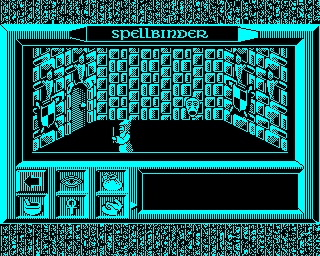
Note to TOM (UK) - the game you're describing sounds like Spellbinder by Superior Software. It was monochrome and set entirely in a castle - a screenshot can be seen here: http://www.stairwaytohell.com/electron/scr/Spellbinder-elk.gif\
. Stairway To Hell is also an excellent site for game downloads. |
|
| author |
date |
text |
| Gustavo Fernandes (Brazil) |
Sunday 15th May 2005 |
My ACORN BBC B+ board is faulty. Is there any dealer for old ACORN boards ? ( I have already tried CJE).\
Is there any compatible board to which I can move the BBC´s EPROMs ? |
|
| author |
date |
text |
| TOM (UK) |
Wednesday 27th April 2005 |
WE used them in school too, remember granny's garden? i'm trying to find the name of a game i remember playing once on the electron. i believe it was side view, and you could walk up, down left or right a bit like maniac mansion, except that you had direct control over the character. you started with water to your right, i think, and you couldn't swim. i think there was something about being able to mix potions or something. there was someone when you got so far through it who threw some sort of homing thingy that seemed to kill you every time. games back then were hard! anyone know what it was called? thanks if you can help!! |
|
| author |
date |
text |
| Philip Trott (Kent) |
Thursday 14th April 2005 |
I still have a BBC B computer and loads of software for it and it still works today I think that says something about the quality of the machine |
|
| author |
date |
text |
| Thibaut (Belgium) |
Monday 14th March 2005 |
This was a stunning wachine. My father, my brother and I bought it in Belgium in 1982. We paid 120.000 BEF (3.000?) for a set comprising : - BBC Model B (40.000 BEF) - 1 double sided disk drive unit (we wanted 2 1 side units, but the seller claimed there were no more, so he gave out the double sided unit. I was mad at him) (30.000 BEF) - 1 EPSON RX 80 matric printer (25.000 BEF) - 1 Sony color TV, used as a monitor (25.000 BEF). Can you imagine that we paid at that time the price of a modern computer for a 5 1/4 disk unit ? In addition to the numerous softwares we exchanged at school, we added a word processing ROM and a utilities ROM called Disc Doctor. I did a lot of things with this computer : programs that applied theories of my maths courses (functions study, matrixes, ...), accountancy, word processing, ... We could even print graphs on a 80 column matrix printer with a utility called "DUMP", that copied pixel by pixel the status of the screen... |
|
| author |
date |
text |
| Alastair Montgomery (North Yorkshire) |
Thursday 13rd January 2005 |
The BBC B, was the third computer I used, I started of with a ZX81, then got an Acorn Electron, finally got a second hand BBC B. Best games IMO were Elite, Revs and Chuckie Egg.
Did a lot of programming on the BBC, Pascal, Basic and assembler.
Wish today's computers would boot up as fast as my old BBC. |
|
| author |
date |
text |
| Clare (Wales UK) |
Thursday 30th December 2004 |
Hi, I was wondering if anyone could help me with an Archemedis A5000 problem, if not, do you know where I can get help?\
I recently got hold of one of these machines, plugged it into my PC monitor and it all worked fine. When I was playing with the resolution settings, I set it to something the PC monitor cannot handle. Now I cannot get it back. Anyone know how to do this?
Please Help,\
Clare. |
|
| author |
date |
text |
| Jonathan Bluestone (London, England / Oklahoma City, OK, USA) |
Wednesday 29th December 2004 |
I'm in *love* with the BBC Microcomputer, and more so with the Master 128 which I brought when they first came out from Watford Electronics ... quite a drive from Hayes, Middlesex, just to buy the new machine. And the reason I purchased it was to play Elite with sixteen colors no less! I'm a massive classic Elite fan (and to a lesser extent, Frontier and First Encounters) and I'm always interested in talking to anyone who has any old Beeb bits, machines they don't want ... or who just want to talk Beeb. I use and can highly recommend a BBC emulator which emulates the Electron, Model B, B+, 65C02, and even the Master 128 to a high degree of accuracy called pcBBC (which runs under MS-DOS, Windows 98se at least) - sadly no longer produced or supported, so if you want to know more about this product, feel free to contact me with the subject PCBBC or BBC in the subject line or I'll ignore messages as spam. |
|
| author |
date |
text |
| Rob D (Solihull, UK) |
Sunday 5th December 2004 |
Morning all,\
I wonder if anyone can help: There was a BBC B game when my fiancee and I were at school, and we're trying to remember the name of it.
It was set on a desert island. You survived by eating tapioca, and sometimes you got a fever/ malaria (we can't recall exactly). It may have been educational (they allowed us to play it at school!). Can anyone remember what it's called?\
Cheers |
|
| author |
date |
text |
| Pugwash (UK) |
Tuesday 17th August 2004 |
My older borther bought the Model A in it's year of release. It was later upgraded to almost "B" spec by him before leaving it for me to use. I added 128MB of internal sideways ram, speech chip, 100kb floppy drive and colour monitor. I learnt programming on the machine and subsequently did a degree and worked for 10 years in programming.\
Most programmers I know had a BBC rather than a Spectrum. |
|
| author |
date |
text |
| Nigel (New Zealand) |
Tuesday 27th April 2004 |
There used to be an upgrade kit to convert an 'A' to a 'B' - I think that apart from RAM, this also included the addition of a cassette tape interface. |
|
| author |
date |
text |
| james rymer (epsom england) |
Friday 5th March 2004 |
hello\
i remember when i was at school we used to have\
BBC a,b i soon learnt BASIC ,they were good days then we also had a computer club\
i still remember if a any one does the strange things you could do with *fx and *tv function\
i think i can`t remember but one *fx function you could lock up the whole keyboard and pressing BREAK did`nt restore things you had to switch the machine off and let it reboot\
also i think at the time (1984) there was a voice systheseizer chip that went in side the machine\
so you could use a program and make human sounding words also there was the AMX mouse\
i never had a BBC at home (too expensive)\
i had an electron so i suffered with no mode 7 |
|
| author |
date |
text |
| Kostya Bezgin (Kiev, Ukraine) |
Tuesday 3rd February 2004 |
Hi!\
I am from Kiev, Ukraine\
I have still working BBC B\
Now working on project called BeebUX - BBC B 8bit multitasking Linux liko os base on Commodore system LUnix and TCP/IP stak Contiki\
Now a wor adding PC D-Dlink extrnbal Ethernet card Paraport-2 to UserPort and buld 8bit PC ISA bus for drive IDE HDD, CD and 1.44 FLoppy\
MY ICQ: 11884009\
Phones\
celleular +(38-039) 247-1048\
home +(38-044) 565-2500 , +(38-039) 565-2550\
work phone +(38-039) 572-5701\
work phone/fax +(38-039) 572-3963 |
|
| author |
date |
text |
| Dave Gamble (UK) |
Sunday 6th April 2003 |
I remember the launch of the BBC Micro model A and B. I first read about them in the U.K. computer press and as a 13 year old at that particular time, drooled over the spec of the model B machine. I then saw them used on the BBC TV program called "The Computer Program" host by Chris Searle. I wanted a BBC micro! But, they were £299 and £399 respectively for the Model A and B. I eventually "made do" with a Commodore 64.\
It is great testiment to the design of these machines, that they are still in use at my son's local primary school, albeit the "Master" version. AMAZING! |
|
| author |
date |
text |
| Blackjack (Brighton UK) |
Wednesday 26th March 2003 |
I always wanted a BBC B but I was at school then and simply couldn't afford the cost, about £400. Instead I looked at the Electron instead, but they still cost £200! I simply couldn't afford that. Then the price came down to £130 and due to a legacy I could finally shell out the cash. I also bought the expansion units. However I was disappointed. The machine was slow due to the lack of onboard hardware the games were very inferior compared to the BBC Micro version!
But I always wanted a BBC B! Later when I left school I had finally afford what I wanted - but it had been replaced with the BBC Master! I thought about the Compact but I thought, "no way, it'll just be another Electron!", and I was right. Ah, but the Master 128 was brilliant, just what I had always wanted and should have bought in the first place! A rtruly great machine, I loved it, programmed it, played games on it!
Later Acorn brought out the Archimedes range. I remember thinking "nice machine, but theres no sofware for it!" And the price! Poor old Acorn never had much of a head for marketing and making a machine that refused to run any "proper" software i.e games etc for the old machine really killed it's own market and the new machine never really took off. Downward compatibility was something that Microsoft/Intel knew all too well. Ah well. |
|
| author |
date |
text |
| nog (Brighton UK) |
Thursday 6th March 2003 |
I remember when my father brought a BBC B back in the 80's, I think he payed about £400 for it, He then nicked a twin 3.5inch disc drive from work, and we re-wired it so it would function. I was hooked. I learned to program it from a very young age and was addicted to games like Elite, Repton. Codename Droid, Frak, etc.Its still up in the loft, in a box. :) |
|
| author |
date |
text |
| jay (uk) |
Thursday 6th February 2003 |
the was a flood at my school and most the bbc's\
were dameged so i rescude 2 bbc pc\
they have no disck-drive and i have saved a\
acorn A5000 but has any one got a disck drive\
i wold like to buy it form any one |
|
| author |
date |
text |
| Roosta (UK) |
Saturday 1st February 2003 |
Ahh, the ol' Beeb.\
apart from the criminally small amount of initial memory and limited palette, this was a truly great computer.\
Not only did it originate some of the greatest games ever (the wireframe masterpiece with 2nd processor support 'Elite' , Citadel, Chuckie-egg, and Exile) it was built to survive .. err a nuclear bomb or something, had proper keys, MASSIVE upgrade potential, the best version of Basic in ROM (BBC basic), and can still occasionally be seen in the corner of laboratories, dust covered but quietly running some piece of essential homemade software that simply doesn't need to be ported to some unreliable 2ghz behemoth PC.
In Short, it was a REAL computer in an age of flimsy games computers.
Having made the Beeb and languishing for a few years, Acorn went on to produce what I believe is the greatest microcomputer to date - the Acorn Archimedes. But that's another matter ...\
RIP Acorn, May Microsoft burn in hell along with Acorn's marketing people ;-) |
|
| author |
date |
text |
| Richard Palmer (UK) |
Thursday 1st August 2002 |
The BBC model Bwas my first computer. I can recall my father's face when he parted with £399 UKP in 1983 for a box including many add ons. The computer was excelllent despite it's price and I still came across models 10 years later in the labs at university.
The BBC used to shamelessly plug their computer. When 'Elite' was released in 1984 it featured as a main news item on the 6pm BBC UK national news. Mind you it was a classic game.\
BBC BASIC was an excellent programming tool and because of the wide use of the systems across UK schools it was taught in the classroom |
|
| author |
date |
text |
| David Noke (Australia) |
Monday 20th May 2002 |
I particularly liked the innovative "copy" key. Very handy when tpye out those lines of Logo! |
|
| author |
date |
text |
| Nevermind (Norway) |
Sunday 28th April 2002 |
I think perhaps one of the best BBC games was "Scramble" - am I right ? I miss the screenshot in the "Software Info".
I used to test the different home computers at the time for speed by running the simple for n=1 to 1000, print n, next n - and Dragon 32 (forth-based) was the quickest until I tested the BBC...it rocked :-) |
|
| author |
date |
text |
| Nelson Bowker (UK) |
Wednesday 3rd April 2002 |
A hard disc drive was available via the 1 Mhz bus port, from which which hardware card with a rom talked to the old sasi disc drive interface, released at about the same time as the second processors arrived at £500\
I have one - bought second hand! A whole 10 MB in my cse - which was a lot of programs then!!!! |
|
|
| /museum/acorn-computer-atom |
| /museum/acorn-computer-bbc-master |
| /museum/acorn-computer-bbc-master-aiv |
| /museum/acorn-computer-bbc-master-compact |
| /museum/acorn-computer-electron |
|
29 |
|

 yann64andClaude Opus 5.5
c913d792c4
yann64andClaude Opus 5.5
c913d792c4